

Why Fitness Supplements Vary in Quality
Last Updated: November 15, 2026
Quick Summary
Fitness supplements vary in quality because regulation is loose, manufacturing standards differ wildly, and labels don't always match what's inside the tub. Supplements are regulated more like food than medicine, so many products hit shelves without anyone checking them first. A responsible brand tests every batch, while a careless one skips it entirely, and both can legally sell to you.
- The FDA's guidance confirms firms, not regulators, are responsible for making sure supplements are safe and accurately labeled.
- Batch-to-batch differences come from ingredient sourcing, mixing and dosing errors, storage and shipping, and quality assurance checks.
- Look for a seal from an independent lab and verify the certifying body covers purity, potency, or banned substances.
- A certificate of analysis should show a matching lot number, active ingredient amounts, contaminant results, and a recent test date.
- Calculate cost per gram of active ingredient rather than per scoop, since a lower price per serving can be misleading.
Table of Contents
- Why Fitness Supplements Vary in Quality
- Loose Regulation Leaves Room for Error
- Manufacturing Practices and Batch Variation
- How to Choose High Quality Supplements
- Third-Party Tested Supplements and What Seals Actually Mean
- Protein Powder Side Effects and What They Tell You
- Which Type of Protein Powder Is Best for Muscle Gain
- Reading a Certificate of Analysis Before You Buy
- The Bottom Line on Supplement Quality
- Frequently Asked Questions
Why Fitness Supplements Vary in Quality
Walk into any supplement shop and you'll see two protein tubs sitting side by side, both promising faster recovery and bigger gains. One costs twice as much as the other. Here's the uncomfortable truth: fitness supplements vary in quality because regulation is loose, manufacturing standards differ wildly, and labels don't always match what's inside the tub. This guide breaks down why that gap exists, and how to spot a quality product before you spend a cent.
The core problem comes down to one thing. Supplements are regulated more like food than like medicine. That means many products hit shelves without anyone checking them first.
Below, we'll show you how to read a label, decode a testing seal, and avoid the traps that catch most buyers.
Loose Regulation Leaves Room for Error
The biggest reason quality varies so much is simple: no one approves a supplement before it's sold. In many markets, including the US, dietary supplement regulation puts the burden on companies to police themselves. The FDA's guidance on dietary supplements confirms that firms are responsible for making sure their products are safe and accurately labeled, not regulators.
That creates a gap. A responsible brand tests every batch. A careless one skips it entirely. Both can legally sell to you.
So what actually separates them?
- Ingredient accuracy: does the label match the contents?
- Contamination control: are heavy metals, fillers, or banned substances kept out?
- Dosage honesty: are active ingredients present at the stated amounts?
A common mistake is assuming a big brand name guarantees quality. It helps, but it doesn't prove anything. Independent testing is the only real proof.
Manufacturing Practices and Batch Variation
Even the same product can differ from one batch to the next. That's because manufacturing practices drive quality, not just the recipe. A facility with tight quality control produces consistent tubs. A rushed one produces variation.
Here's where batch-to-batch differences come from:
- Ingredient sourcing: suppliers change, and so does raw material quality
- Mixing and dosing: small errors in a large batch add up
- Storage and shipping: heat and moisture degrade ingredients
- Quality assurance checks: some facilities test every batch, others test rarely
What most guides miss is that a single good review doesn't mean the next batch is good. Quality has to be verified repeatedly, not once.
How to Choose High Quality Supplements
Choosing high quality supplements comes down to verifying three things: what's in the product, who tested it, and whether the label is honest. Follow this checklist before you buy anything.
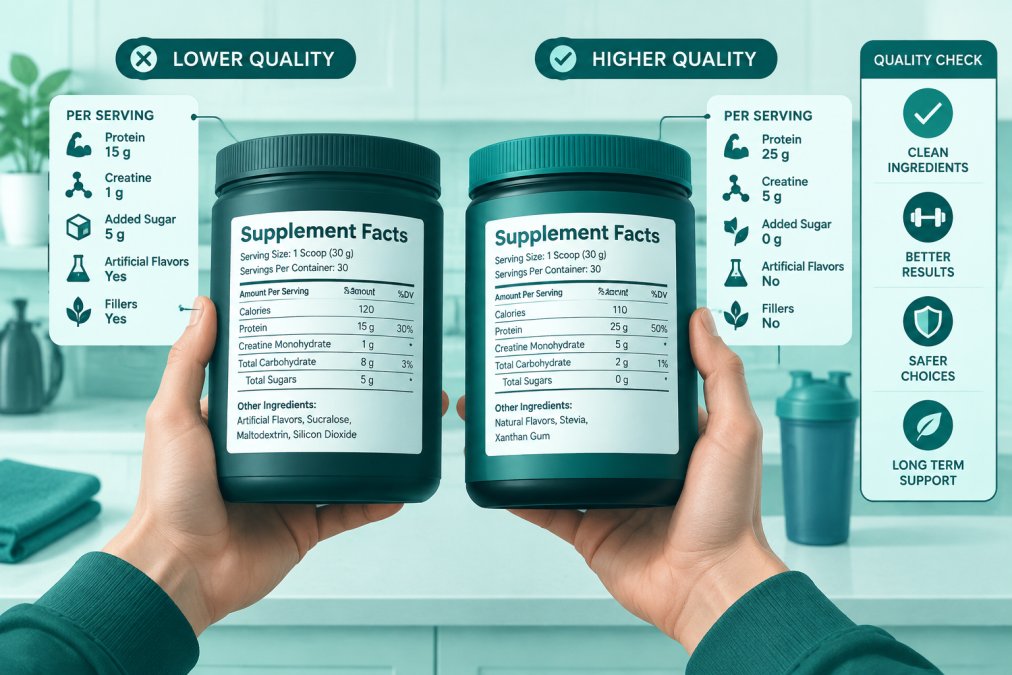
Step 1: Read the ingredient list, not the front label. The front is marketing. The back tells the truth. Look for the specific forms of ingredients (e.g., whey isolate vs. concentrate, creatine monohydrate vs.
Step 2: Check for third-party testing. Look for a seal from an independent lab. Verify the certifying body is reputable and that the seal covers the tests you care about (purity, potency, banned substances).
Step 3: Watch for proprietary blends. These hide individual ingredient amounts behind one total figure. Without knowing the dose of each active ingredient, you can't assess whether the product is effective.
Step 4: Verify the dosage. Compare the active ingredient amount to what clinical research uses.
Step 5: Check the batch. A certificate of analysis proves a specific batch was tested. Request or download the COA and confirm the lot number matches the product you're considering.
Step 6: Compare cost per effective dose. A lower price per serving can be misleading if the product uses a less absorbable form or underdoses key ingredients. Calculate the cost per gram of active ingredient rather than per scoop.
For a deeper walkthrough, see our guide on 5 Steps to Verify Supplement Ingredient Safety.
Third-Party Tested Supplements and What Seals Actually Mean
Third-party tested supplements carry a seal from an independent lab that checked the product for purity, potency, and contaminants. But not all seals are equal. Some test for banned substances, others only for basic safety. Understanding what each seal actually verifies, and what it doesn't, is essential for making an informed choice.
Here's what to look for:
- Banned-substance seals: important for competing athletes. These programs test for substances prohibited by organizations like the World Anti-Doping Agency (WADA).
- Purity seals: confirm no heavy metals, fillers, or harmful microbes. They may not verify potency.
- Potency seals: verify the label matches the contents for specific active ingredients, but may not screen for all contaminants.
A seal is a signal, not a guarantee. It tells you one batch passed, at one point in time. To dig deeper, ask for a certificate of analysis (COA). A COA is a document from a lab showing exactly what a batch contains and what it was tested for. It should include the batch or lot number (matching the product you're buying), active ingredient amounts (confirming label accuracy), contaminant results (heavy metals, microbes, solvents), and a recent test date. If a brand won't share a COA, that's a warning sign. Reputable makers publish them or send them on request.
Watch out: some seals are self-declared by the manufacturer, not truly independent. Look for seals from recognized independent organizations, and verify the certifying body's reputation. The NSF's guide to supplement certification explains how independent certification works and why it matters for safety.
Protein Powder Side Effects and What They Tell You
Protein powder side effects like bloating, gas, or stomach upset can have many causes, including ingredients in the formula.
Watch for these red flags:
- Bloating after a clean product: may signal fillers or lactose you didn't expect
- Unexplained jitters: could mean hidden stimulants
- Digestive upset: often linked to low-quality protein sources
If a product upsets your stomach when a similar one doesn't, the difference is usually the formulation, not you.
Which Type of Protein Powder Is Best for Muscle Gain
The best type of protein powder depends on your goals and digestion. Here's how the main types compare.
| Type | Best For | Digestion Speed | Watch Out For |
|---|---|---|---|
| Whey isolate | Fast post-workout recovery | Fast | Higher cost |
| Whey concentrate | Budget muscle gain | Medium | Lactose sensitivity |
| Casein | Slow overnight recovery | Slow | Thick texture |
| Plant blend | Dairy-free diets | Medium | Lower protein per scoop |
For most people building muscle, a quality whey isolate or concentrate covers the basics. Plant blends work well too, as long as they combine multiple protein sources.
Reading a Certificate of Analysis Before You Buy
A certificate of analysis, or COA, is a document from a lab showing exactly what a batch contains and what it was tested for. It's the single best proof of quality you can ask for.
Here's what a COA should show:
- Batch or lot number: matches the product you're buying
- Active ingredient amounts: confirms the label is accurate
- Contaminant results: heavy metals, microbes, and solvents
- Test date: recent dates matter more
If a brand won't share a COA, that's a warning sign. Reputable makers publish them or send them on request.
The NSF's guide to supplement certification explains how independent certification works and why it matters for safety.
The Bottom Line on Supplement Quality
Quality in fitness supplements isn't luck. It's the result of testing, honest labeling, and tight manufacturing. You now have the tools to check all three.
At HealthHustleHub, we build our supplement and gear range around the same standard: performance you can trust, batch after batch. Our products are designed for comfortable everyday active movement and built to handle regular active routines. If you want gear and supplements that support smooth movement during intense training, we're here for it.
Get started with HealthHustleHub and train with confidence, knowing what's in your tub and on your back.
Frequently Asked Questions
Why do fitness supplements vary in quality?
Fitness supplements vary because regulation is looser than for medicines. In most markets, products reach shelves without pre-market safety approval, so quality depends on the manufacturer. Differences in ingredient sourcing, dosage accuracy, manufacturing practices, and whether a product undergoes third-party testing all create variation. Some brands invest in batch testing and certificates of analysis; others cut corners on formulation and label accuracy. That gap is why two tubs with similar labels can perform very differently.
How can you tell if a protein powder is high quality?
Start with the label: look for a full ingredient list, clear protein amounts per serving, and no vague proprietary blends hiding doses. Then check for third-party tested supplements, ideally with a certificate of analysis you can request or download. A reputable brand will state which lab tested the batch and what was screened for, including contaminants and banned substances. If a brand dodges these questions or makes exaggerated product claims, treat that as a warning sign.
Can protein powders contain contaminants or undeclared ingredients?
Yes. Some products have been found to contain undeclared ingredients or contaminants. This is why batch testing and independent certification matter. A certificate of analysis from an accredited lab shows what was tested and the results for that specific batch. Without it, you are relying on the brand's word. Choosing products with transparent testing reduces your exposure to adulteration and label accuracy problems.
Are expensive fitness supplements better quality?
Not automatically. Price often reflects marketing, packaging, or retail margin rather than ingredient quality. The better measure is cost per effective dose: how much active ingredient you get per serving versus what you pay. A cheaper product with accurate dosing and third-party testing can outperform a pricier one with a proprietary blend. Compare labels, check serving sizes, and verify testing before assuming a higher price means higher quality.
